
How to Be Disciplined and Consistent in Life: 7 Habits That Actually Work
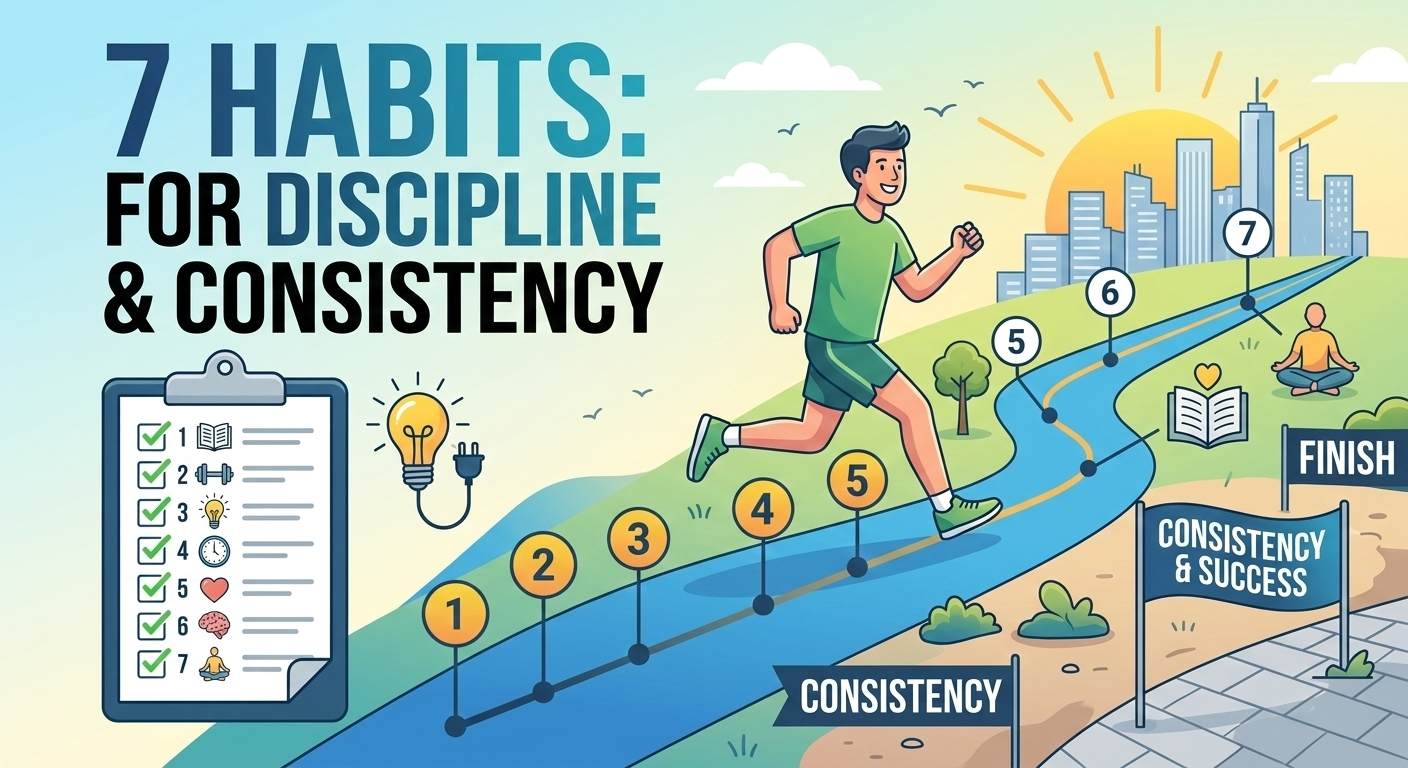
Discipline is the ability to act in line with long-term goals even when short-term comfort pulls in the opposite direction. Consistency is repeating that action over days, weeks, and months until it becomes automatic. Together, they form the foundation of every lasting achievement in life.
Most people already know what they should be doing. The real problem is doing it consistently — on a Tuesday morning when life gets in the way and motivation has completely disappeared.
Learning how to be disciplined and consistent in life is one of the most searched self-improvement topics online — and for good reason. Research consistently shows that self-control, not intelligence or talent, is the strongest predictor of long-term success in health, finances, relationships, and career.
This article breaks down 7 practical, science-backed habits that build lasting discipline and consistency in everyday life — without relying on willpower alone. Whether starting from scratch or rebuilding after falling off track, these strategies work in real life, not just in theory.
Table of Contents
ToggleDiscipline vs. Consistency in Life: What Is the Difference and Why It Matters
Discipline and consistency are not the same thing — but they need each other in everyday life. Discipline is the decision to act when it is hard. Consistency is the habit of making that decision repeatedly over time. Discipline ignites the process; consistency is what keeps it running long after the initial motivation fades.
A common misconception is that disciplined people are simply more motivated than everyone else. In reality, people who stay disciplined and consistent in life have built systems that remove the need for motivation in the first place.
Here is a simple way to understand the difference:
| Discipline | Consistency |
|---|---|
| A single act of willpower | A pattern of repeated acts over time |
| Starts the habit | Sustains the habit |
| Can be forced short-term | Must be built into a system |
| Peaks on Day 1 | Grows stronger over months |
The takeaway: building discipline creates the first action. Building consistency turns that action into a permanent part of daily life. Both are learnable skills — not fixed personality traits.
Why Most People Struggle to Stay Disciplined and Consistent in Life
Before exploring solutions, it helps to understand why the struggle actually exists. Most people who find it hard to be disciplined and consistent in life are not lazy — they are simply using the wrong strategy.
Here are the 4 root causes that silently destroy discipline and consistency in everyday life:
- Vague goals. When the destination is unclear, the brain has no clear target to move toward. ‘Get healthier’ is not a goal — ‘run 3 times a week for 30 minutes’ is.
- Relying on motivation instead of systems. Motivation is an emotion. It fluctuates daily. Discipline, on the other hand, is a system that runs regardless of how someone feels.
- An environment that works against them. Phones with constant notifications, social media at arm’s reach, and no dedicated workspace actively work against self-control in daily life.
- All-or-nothing thinking. Missing one workout does not mean the week is ruined. But for many people, one missed day triggers a complete abandonment of the goal — one of the biggest consistency killers in life.
Pro Tip: The fastest fix for low discipline in life is rarely a motivational speech. It is removing one friction point from the environment — like putting the phone in another room during focused work time.
7 Daily Habits to Be Disciplined and Consistent in Life

These 7 habits are built on behavioral science and are deliberately practical for everyday life. Each one follows the same format: what it is, why it works, and how to start today.
Habit 1: Define the Outcome Clearly
Developing discipline and consistency in life always starts at the same place: clarity. A person cannot commit consistently to a goal they cannot visualize or measure.
James Clear, author of Atomic Habits, describes this as the difference between outcome-based goals and identity-based goals. Both require specificity to work in real life.
- Write the goal as a present-tense statement: ‘I complete a 30-minute workout every morning at 7am.’
- Post it somewhere visible — phone lock screen, bathroom mirror, or the top of a daily planner.
- Review it every morning for the first 2 weeks until it is memorized.
Habit 2: Design the Environment for Success
This is the most underrated strategy for staying disciplined in everyday life — and one that most articles on this topic completely ignore.
The environment shapes behavior more than willpower ever will. A Stanford study found that people with high self-control were not exercising iron willpower — they were simply living in environments with fewer temptations.
- Reduce friction for good habits: lay out gym clothes the night before; keep a water bottle on the desk.
Increase friction for bad habits: delete social media apps from the home screen; put the TV remote in a drawer
Pro Tip: Do a 10-minute 'friction audit' today. For each life goal, ask: What makes this easier? What makes this harder? Then change one physical thing in the space.
Habit 3: Start Embarrassingly Small
The biggest enemy of consistency in life is not failure — it is an unrealistic starting point. Most people quit not because the goal is too hard, but because the starting bar is too high.
According to research published in the European Journal of Social Psychology (ncbi.nlm.nih.gov), habits take an average of 66 days to form — not the widely cited 21 days. [Outbound link 1]
- The rule: shrink the current target by 80% for the first two weeks.
- ‘I will read for 2 minutes’ is a better starting point than ‘I will read for an hour.’ It sounds too easy — and that is exactly the point.
- Once the habit is consistent, scaling up becomes natural rather than forced.
Habit 4: Build a Non-Negotiable Daily Routine
A daily routine removes the need to decide. And every decision avoided is a unit of willpower preserved for things that actually matter.
The concept of anchor habits is key: 1–2 daily actions that the entire routine is built around. Common examples are a morning journal (5 minutes) and an evening review (5 minutes).
- Block the same time slot every day — and treat it like a meeting that cannot be cancelled.
- Morning hours tend to work best for discipline-heavy habits because willpower is highest early in the day.
Habit 5: Eliminate the Top 3 Distractions
Being disciplined and consistent in life is not only about adding good habits — it is also about removing what makes consistency harder. Distractions are not a personality flaw. They are a design problem.
According to the American Psychological Association (apa.org), chronic stress and information overload are among the top reported barriers to self-control in daily life.
- Identify the top 3 personal distraction triggers. For most people, they are: smartphone notifications, social media, and an unstructured workspace.
- Use implementation intentions: “When I sit down to work, I will put my phone face-down in another room.”
- Try one 25-minute focused session (Pomodoro method) with zero distractions to prove to the brain that it is possible.
Habit 6: Track Progress Visually
What gets measured gets managed. Visual tracking creates a psychological loop that makes consistency in life feel rewarding rather than effortful.
Jerry Seinfeld’s “don’t break the chain” method is one of the simplest and most effective tracking systems ever described. Mark each day a habit is completed on a physical calendar. The goal becomes protecting the streak.
- Tools: a simple paper calendar with X marks, or apps like Habitica or Streaks.
- Celebrate every 7-day streak with a small, meaningful reward.
- Track only 1–3 habits at a time. Tracking more creates decision fatigue and often leads to abandoning the system entirely.
Habit 7: Use an Accountability Partner or System
Accountability is one of the most powerful tools for staying disciplined and consistent in life. A study by the American Society of Training and Development (ASTD) found that having a specific accountability partner increases goal achievement rates by up to 65%.
- Options: a trusted friend, an online community, a paid coach, or a public commitment post on social media.
- The key is specificity: ‘I am committed to working out at 7am on Monday, Wednesday, and Friday. I will text you when I am done.’
Action Step: Text one person today. Tell them the single habit goal for this week and ask them to check in on Friday.
How to Stay Disciplined and Consistent in Life After Falling Off Track
Everyone misses a day. The difference between people who build lasting discipline and consistency in life and those who give up is not that the former never fail — it is that they have a recovery strategy.
The ‘never miss twice’ rule: Missing one day is human. Missing two days in a row is the beginning of a new (bad) habit. The moment a habit is broken, the only priority is getting back to it the very next day — even if it means doing a 5-minute version instead of the full routine.
Here is a simple recovery protocol for getting back on track after losing discipline in life:
- Do not wait for Monday. Restart the next morning, even with a scaled-down version of the habit.
- Reframe the missed day as data, not failure. Ask: What specifically got in the way? Then address that one obstacle.
- Reduce the target temporarily. If a 45-minute workout was missed, start again with 10 minutes. The goal is to re-establish the pattern, not to compensate for lost time.
Progress over perfection is not a motivational cliche — it is a strategy. Eighty percent consistency over 90 days produces dramatically better results than 100% consistency for two weeks followed by a complete reset.
Tips for Being Disciplined and Consistent in Life: Quick-Reference Summary
Here is a complete list of all 7 habits for building discipline and consistency in life, along with the single most important action step for each:
| Habit | One Action Step |
|---|---|
| 1. Define the Outcome | Write your goal as a present-tense achievement statement |
| 2. Design the Environment | Do a 10-minute friction audit of your workspace |
| 3. Start Embarrassingly Small | Shrink your current habit target by 80% for 2 weeks |
| 4. Build a Daily Routine | Block the same anchor time every day — no exceptions |
| 5. Eliminate Distractions | Phone in another room during every focus session |
| 6. Track Progress Visually | Set up a habit tracker tonight for your #1 habit |
| 7. Use Accountability | Text one person today with this week's habit commitment |
Frequently Asked Questions
How long does it take to become disciplined and consistent in life?
There is no fixed timeline, but research gives a useful benchmark. A UCL study led by Dr. Phillippa Lally (published in the European Journal of Social Psychology) found that new behaviors take an average of 66 days to become automatic — ranging from 18 to 254 days depending on the person and the complexity of the habit.
The most important variable is not time — it is consistency in daily life. Someone who practices a habit 5 days a week will build discipline significantly faster than someone who attempts it randomly.
Can someone be disciplined and consistent in life without motivation?
Yes — and this is one of the most important mindset shifts for building lasting discipline in life. Motivation is an emotion that rises and falls unpredictably. Discipline is a system that operates independently of how someone feels on a given day.
The goal is not to feel motivated — it is to build daily habits so deeply ingrained that action happens automatically, the way brushing teeth does not require motivation each morning.
What is the fastest way to build consistency in life?
The fastest path to consistency in life is to pick one habit, make it small enough to be almost effortless, and track it visually for 30 days. Most people fail at consistency because they try to change too many things at once.
Start with one anchor habit (see Habit #4 above). Once that habit is automatic — typically after 4–6 weeks — add a second one. Stacking habits gradually is significantly more effective than overhauling everything at once.
Final Thoughts: Learning How to Be Disciplined and Consistent in Life Is a Skill, Not a Gift
The most important thing to understand about how to be disciplined and consistent in life is this: it is not a personality trait some people are born with. It is a skill set that anyone can develop with the right systems, environment, and habits.
Nobody becomes consistent by trying harder. They become consistent by making the right action easier and the wrong action harder — one small system at a time.
The only rule: pick one habit from the list above and commit to it for the next 7 days. Not a month. Not a year. Just 7 days.
Building discipline and consistency in life is only the beginning. The next step is putting that discipline to work in areas that truly matter — like protecting your financial future. If you are ready to take control, read our guide on how to protect your money against inflation and start making your consistency count where it matters most.